Skip to content
Cure Blau Syndrome Foundation

Education

Learn from the people closest to Blau syndrome.

We build education on Blau syndrome through social media, online forums and research symposiums. Our recorded events bring leading experts together to brainstorm research ideas and to inform the people living with and affected by Blau.

Living with Blau

Voices from the community.

A video series in which people with Blau syndrome share what it is like to live with the disease.

Featuring

Lauren Ennis

Lauren Ennis shares her experience of living with Blau syndrome.

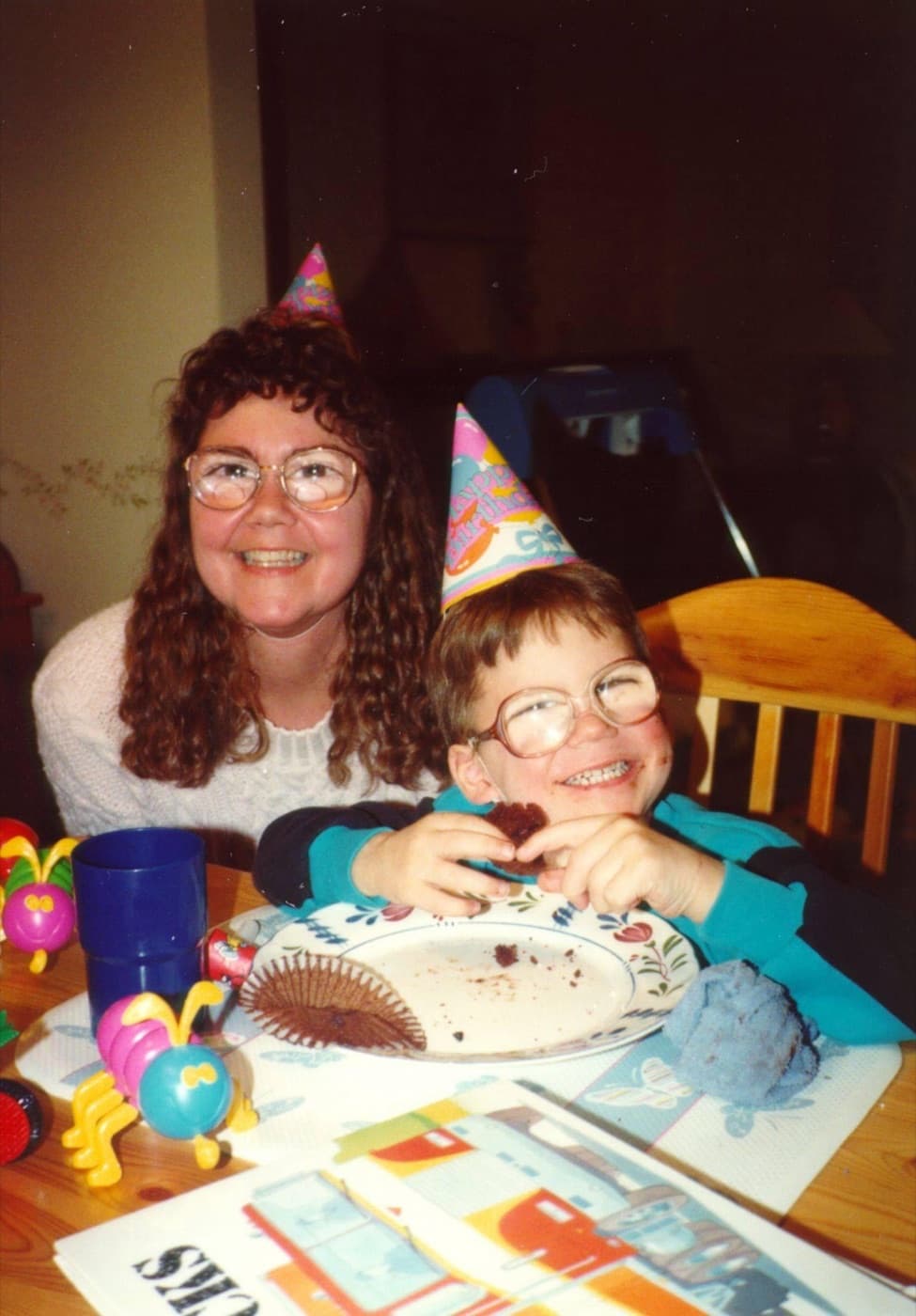
Kathleen Mears with her son Brian

Featuring

Kathleen Mears

Kathleen has lived with Blau syndrome for over 60 years. She shares her journey, including the loss of her son Brian to the disease, and how she continues to find strength and joy.

The videos are shared on the Foundation’s Facebook and Instagram channels.

Immune Mysteries

Shedding light on Blau syndrome.

A recorded webinar on Blau syndrome as a single-gene granulomatous disease.

Webinar on YouTube

Blau Syndrome: A Monogenetic Granulomatous Disease

Watch on YouTube
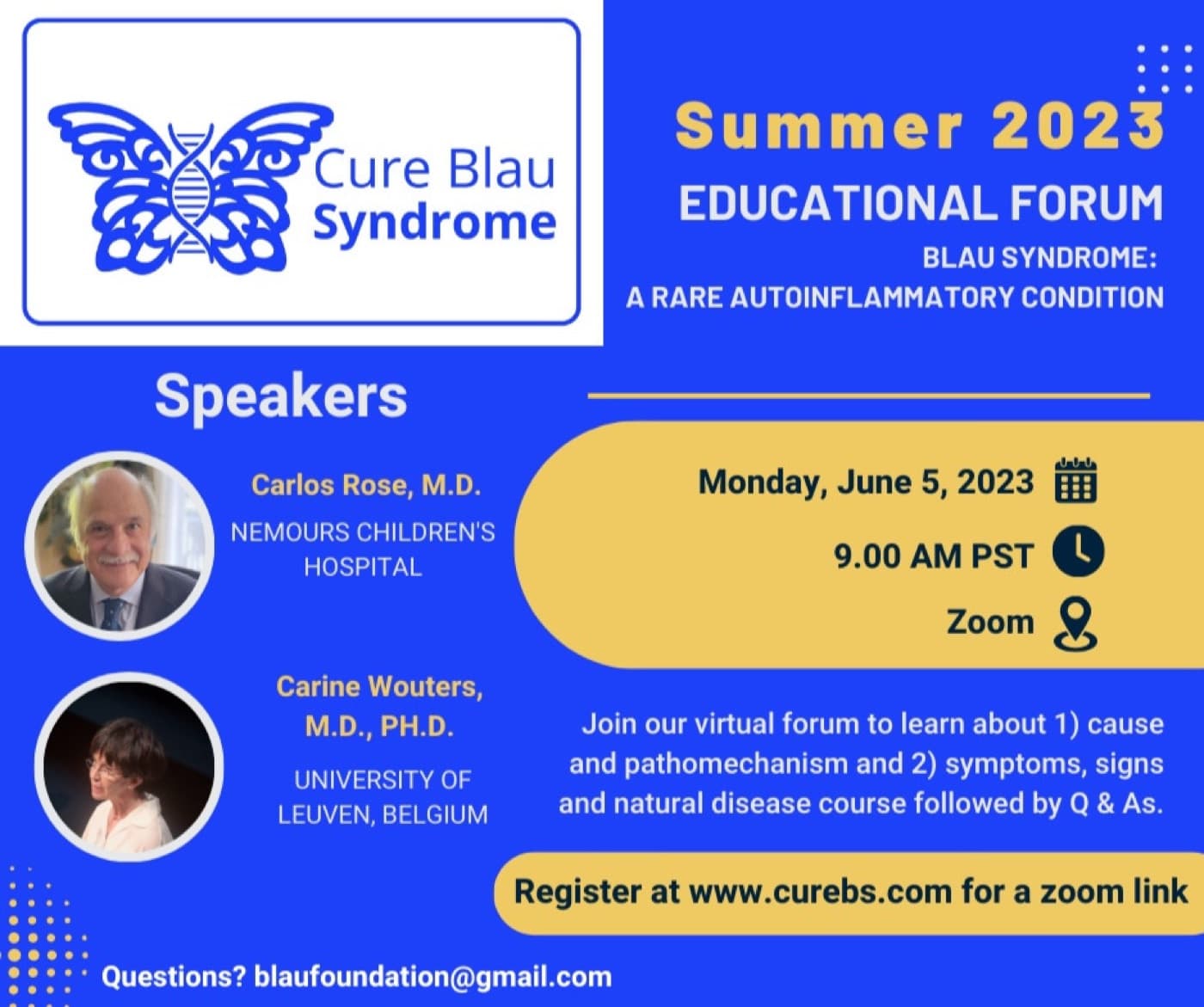
Poster for the Summer 2023 Educational Forum, Blau Syndrome: A Rare Autoinflammatory Condition, with speakers Carlos Rose, M.D., of Nemours Children's Hospital and Carine Wouters, M.D., Ph.D., of the University of Leuven, Belgium, on Monday, June 5, 2023 on Zoom

June 2023 Educational Forum

Dr. Carlos Rose and Dr. Carine Wouters.

On June 5, 2023, two of the world's leading Blau experts joined families online for a virtual forum: Blau Syndrome, A Rare Autoinflammatory Condition.

  • Carlos Rose, M.D.Nemours Children's Hospital
  • Carine Wouters, M.D., Ph.D.University of Leuven, Belgium
  • Part oneCause and pathomechanism of Blau syndrome
  • Part twoSymptoms, signs and natural disease course, followed by Q&A

Blau Syndrome Research Panel, August 2020

Five researchers, five new angles on Blau.

Our first research symposium brought scientists from the United States, Japan, Canada, France and Belgium together with the Blau community. Affiliations are as of the panel.

Dr. Ruth J. Napier

  • Assistant Professor, Molecular Microbiology and Immunology, Oregon Health & Science University
  • Principal Investigator, Research Microbiologist, VA Portland Health Care System

Topic

NOD2 T cells: New insights into the pathogenesis of Blau syndrome

Dr. Napier runs a translational immunology laboratory at the VA Hospital in Portland. Her research program focuses on how microbial sensors, including the NOD2 gene, control pathogenic cellular responses in autoimmune and autoinflammatory diseases, and she hopes to use this to advance therapeutics for Blau syndrome. She presented her latest research, which found an unexpected role for NOD2 in suppressing the pathogenic T cells that cause arthritis and uveitis. These findings add to the understanding of how Blau syndrome develops and point to new treatment options. The presentation focused on the potential of IL-17 as a treatment for Blau. Dr. Napier is one of very few researchers in the world with Blau mice in her lab, and she showed images of mice with Blau syndrome and how they respond to IL-17. One of the most controversial findings was the possibility that Blau syndrome may be a loss-of-function, rather than a gain-of-function, mutation as previously believed. Dr. Napier explained that her new findings are limited by the small number of patient samples she currently has.
Dr. Naotomo Kambe

  • Associate Professor, Department of Dermatology, Kyoto University Graduate School of Medicine

Topic

Clinical characteristics and treatment of 50 cases of Blau syndrome in Japan

Dr. Kambe has co-authored more than 100 publications on Blau syndrome and autoinflammatory disorders. His most recent publication followed 50 patients with Blau syndrome; in such a small population, this is one of the largest cohorts ever studied. He presented his clinical observations and disease specifics. In many patients, disease onset was recognized after BCG vaccination. Most patients who became blind had been treated with non-biologics, whereas none of the patients treated with biologics from a young age were blind. His presentation highlighted the need for more research and better treatment options.

Dr. Gregory D. Fairn

  • Associate Professor, Departments of Biochemistry and Surgery, University of Toronto
  • Keenan Research Centre for Biomedical Science, St. Michael's Hospital, Unity Health Toronto

Topic

Acylation of NOD2 controls its subcellular targeting and signaling

Dr. Fairn presented his latest findings from a grant on Crohn's disease research, which offered insight for Blau syndrome. His team discovered that the peptidoglycan sensor NOD2 needs fatty acids added after translation (acylation) to sit in the right place in the cell and signal in response to peptidoglycan. They also found that many human NOD2 mutations associated with Crohn's disease are inefficiently acylated, which explains their loss-of-function phenotype. In contrast, the C495Y mutant associated with Blau syndrome shows hyper-acylation in the absence of peptidoglycan while stimulating inflammatory signaling. Restoring NOD2 C495Y acylation to baseline reduces pro-inflammatory signaling in cells, so manipulating NOD2 acylation could be beneficial for treating Blau syndrome.

Jean-Marie Brusq

  • Senior Program Director, Head of Translational Pharmacology, Oncodesign Biotech Business Unit, France

Topic

Discovery of ODS-101, a RIPK2 inhibitor, for the treatment of inflammatory diseases, via Nodosome regulation

Mr. Brusq is a former GlaxoSmithKline investigator. He joined Oncodesign in 2016 to lead a team that spent three years developing ODS-101, a new RIPK2 inhibitor that holds promise as a potential treatment for inflammatory disorders. There has been a lot of discussion about RIPK2, and it is exciting to hear that it could become a more targeted treatment option for Blau syndrome. According to the latest research, strong genetic evidence directly links the NOD2-RIPK2 axis to Blau syndrome, so RIPK2 was chosen as the most tractable target in this pathway to inhibit nodosome overactivation.

Kourosh Ahmadzadeh

  • PhD student, Rega Institute, KU Leuven, Belgium
  • Supervised by Prof. Dr. Carine Wouters, Prof. Dr. Patrick Matthys and Dr. Carlos Rose

Topic

Study of granuloma and giant cell formation in Blau syndrome

Mr. Ahmadzadeh presented his findings on how giant cells and granulomas form in autoinflammatory diseases, with a focus on Blau syndrome. He used complementary, cutting-edge technologies, including live cell analysis, advanced flow cytometry, RNA sequencing and proteomics, with the aim of finding a better therapy for Blau patients. He works under the supervision of world-renowned Blau experts Dr. Wouters, Dr. Matthys and Dr. Rose, who also joined the question and answer session.

Documentary

Rare Humans: Turning Research into Action.

This documentary follows eight rare disease families changing the future of medicine as they pursue their missions to cure the incurable. Their stories of love, loss and determination prove that every one of us can turn hope into action.

Every dollar, every hour, every voice matters.

Rare disease research only moves when families and supporters push it. Your gift funds research directly, and your story in the registry gives scientists data they cannot get anywhere else.